The DOJ’s ADA Title II Deadline Extension: What Changed and What Still Applies

Table of Contents
If your agency spent early 2026 racing toward an April 24 ADA compliance deadline, the U.S. Department of Justice’s announcement on April 20 probably felt like a reprieve, and in one sense it was. The DOJ’s interim final rule pushed the Title II web accessibility compliance dates back by one year for every covered public entity. The standard, the scope of covered content, and the legal obligation underneath both are unchanged.
I’ve spent much of this year on calls with IT directors and communications leads who want to know one thing: how much breathing room do we actually have? For entities serving 50,000 or more people, the honest answer is about five and a half months, which is enough for one full cycle of audit, remediation, and editor training if the work starts this fall. Here is what the rule says, in its own words, and how I’d recommend spending the time between now and April 26, 2027.
What did the DOJ change in the ADA Title II web accessibility rule?
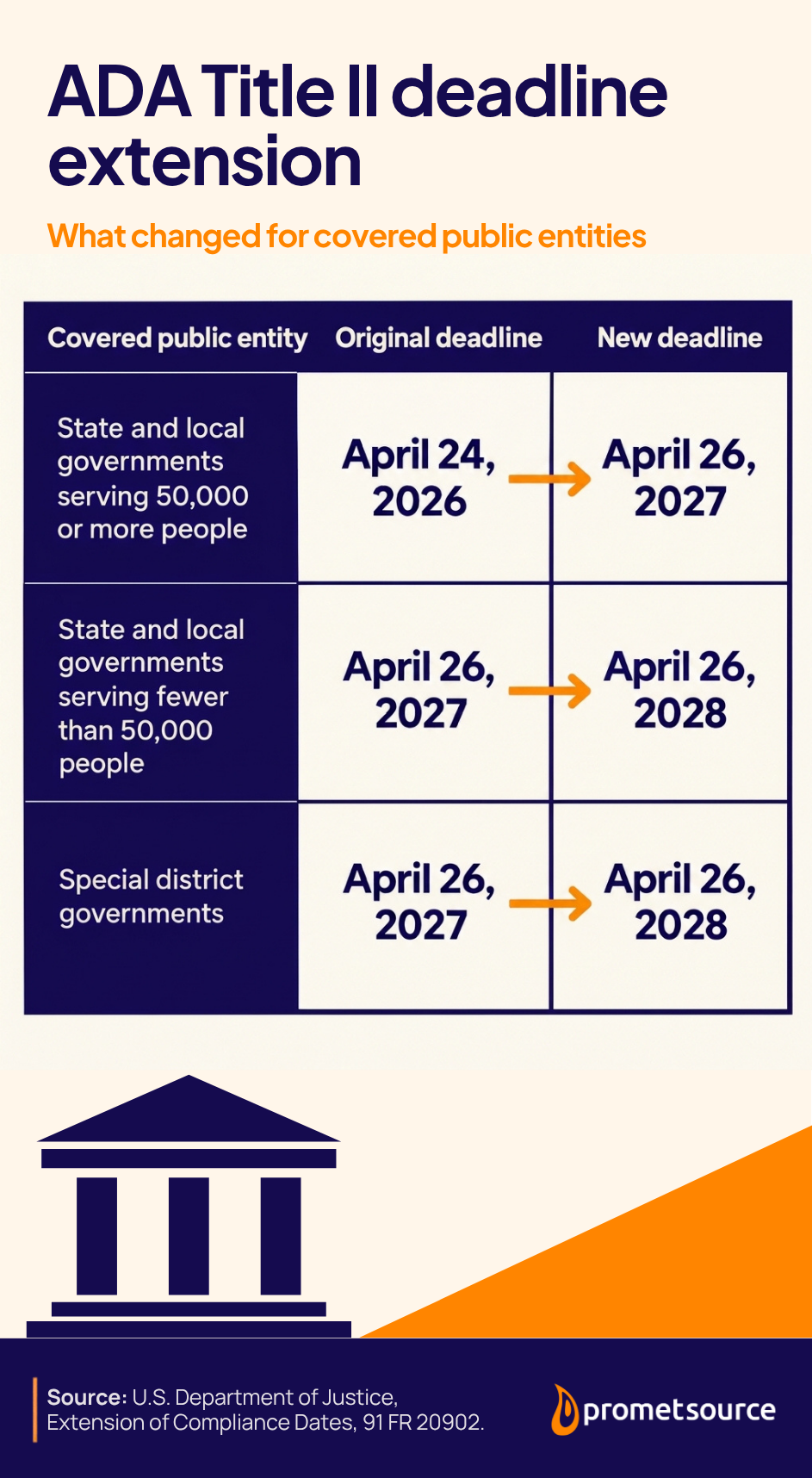
On April 20, 2026, the U.S. Department of Justice published an interim final rule (91 FR 20902) extending the ADA Title II web and mobile accessibility compliance deadline by one year. Public entities serving 50,000 or more people now have until April 26, 2027, and smaller entities and special district governments have until April 26, 2028.
The DOJ estimated that the extension generates about $2.775 billion in present-value cost savings for covered entities over 10 years. It also opened a 60-day comment period, which closed on June 22, 2026, so the dates above are the ones to plan around unless the Department announces otherwise or a court rules on the pending challenge described in the FAQ below.
If your entity serves fewer than 50,000 people, or is a special district government such as a water, transit, or utility district, your date is April 26, 2028, and the plan below applies the same way with a longer runway. Some states also set their own web accessibility requirements, so check your state’s rules alongside the federal dates.
Why did the DOJ extend the Title II deadline?
The DOJ said it had overestimated how quickly public entities could comply with the digital accessibility compliance deadlines. Its April 2026 rule states that generative AI “does not yet reliably automate the remediation of inaccessible content at scale” and that staff resources “continue to pose significant challenges,” which points agencies toward human-reviewed remediation to reach WCAG 2.1 Level AA (91 FR 20902).
That sentence deserves a second read from anyone who has been offered a one-click fix. The federal agency responsible for enforcing the rule has put in writing that conformance still depends on trained people. Automated scanners are valuable for finding common issues quickly, and our team uses them every day. Confirming that a screen reader user can finish a permit application, or that a keyboard user can reach every item in a menu, still takes a specialist working through the page. When I reviewed county websites for an earlier article on the most common accessibility errors, I found examples of non-compliance on every site I checked, and many of them were the kind a trained person catches and fixes quickly once someone is looking.
The rule also names litigation as a reason for the extension. Under the original dates, the DOJ wrote, entities that could not finish in time “would face significant litigation risks,” because Congress created a private right of action in Title II that lets private litigants recover injunctive relief and attorneys’ fees.
What stays the same after the extension?
The WCAG 2.1 Level AA standard, the scope of covered content, and existing ADA duties remain in place. The DOJ’s April 2026 rule says covered entities have “an ongoing obligation” to keep web and mobile services accessible regardless of the compliance dates, and it changes only the dates in the 2024 rule (91 FR 20902).
- The technical standard. WCAG 2.1 Level AA still applies to websites, mobile apps, and the web-based documents public entities provide.
- The scope. The rule covers content your agency provides directly and content provided through contractors and vendors, including PDFs and other documents, subject to the specific exceptions in the 2024 rule, such as archived web content kept only for reference and preexisting documents that are not used to access current services.
- The ongoing obligation. Title II’s existing accessibility and effective communication duties apply today, independent of the new dates.
- The private right of action. Residents can still bring claims under Title II, a point the DOJ made in the extension rule itself.
What should an ADA Title II compliance plan for 2027 include?
An ADA Title II compliance plan for 2027 should cover an audit, remediation, and editor training, each with a date attached. For an entity serving 50,000 or more people, April 26, 2027 falls 168 days after this article’s November 9, 2026 publication date, enough time for one full cycle if work begins this fall (91 FR 20902).
In my conversations with agency teams, the plans that hold up best answer three questions early and then put dates against the answers, which is what the sample schedule at the end of this section does.
1. Which content carries the most risk?
Start with the services residents depend on to get something done: payments, permits, applications, meeting agendas, and emergency information. Those pages carry the highest stakes for residents and the greatest exposure for the agency, so they belong at the top of the remediation list, ahead of older news pages that few people visit. Retiring or archiving content no one uses shortens the list too, and the 2024 rule’s exception for archived web content can cover pages kept only for reference in a clearly marked archive, as long as they meet the exception’s conditions.
2. Who fixes it?
Some issues live in the code of your templates and components, and others live in the content your editors publish. Separating the two early keeps the budget honest, because code-level fixes need a developer while content fixes need training and a process. It is also the right moment to check vendor contracts, since content provided on your behalf is part of the rule’s scope.
3. How does new content stay compliant after launch?
A site that meets WCAG 2.1 Level AA on the compliance date will keep changing the next morning. Editor training, a shared pre-publish checklist, and scheduled monitoring are what keep it there. When I wrote about PDF and document accessibility in February, I called training the only investment that compounds, and the extension gives agencies time to make that investment before the compliance date instead of after it.
A sample schedule that works back from April 26, 2027
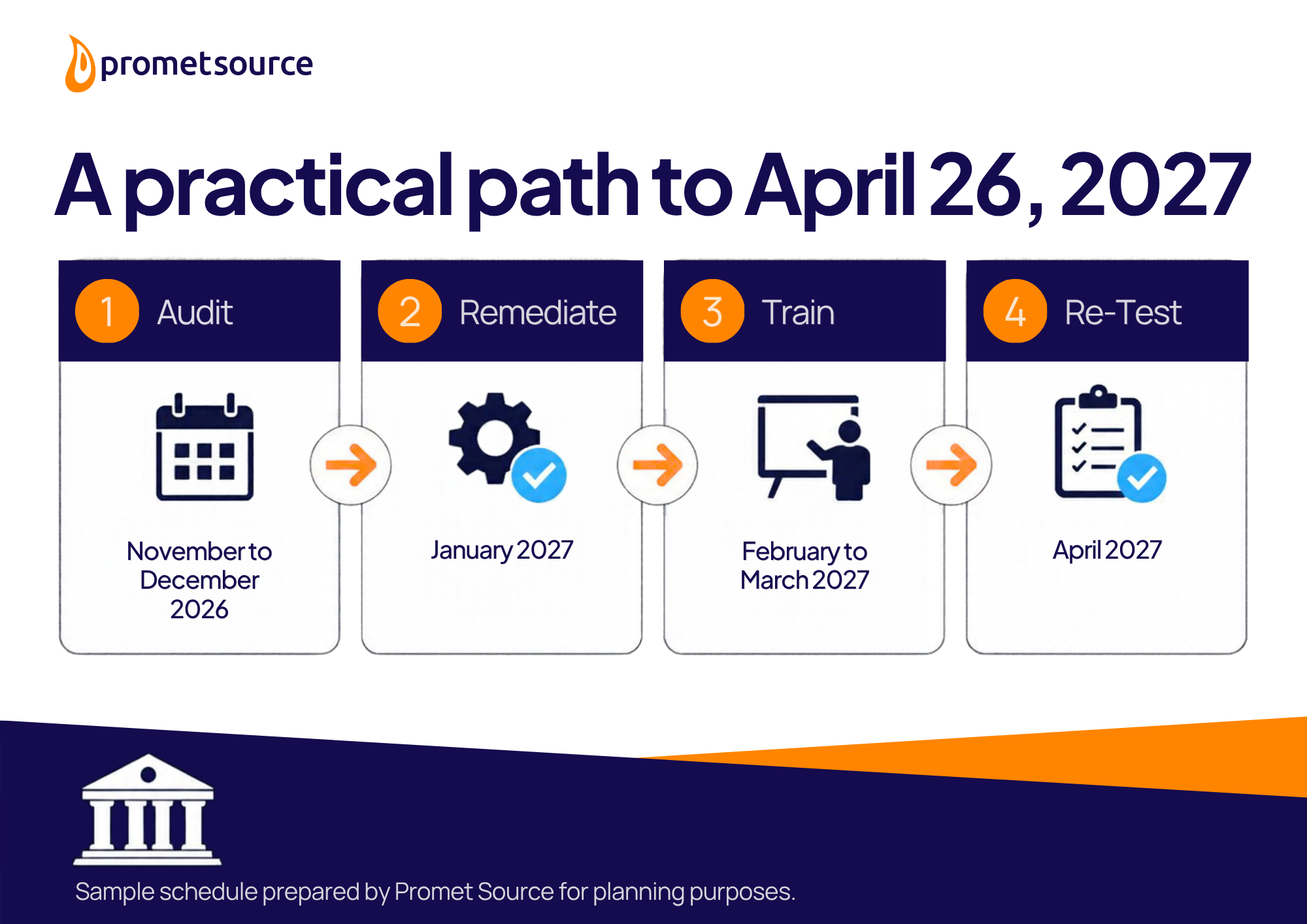
Here is how those three answers can turn into a calendar for an entity serving 50,000 or more people. Procurement rules and approval cycles differ from agency to agency, so treat the windows as a starting point and adjust them to your own budget calendar.
| Window | Focus | What you have at the end |
|---|---|---|
| November to December 2026 | Audit the services residents use most (payments, permits, applications, agendas, emergency information) with manual and automated testing, and list the content vendors provide on your behalf | A prioritized issue list, split into code fixes and content fixes |
| January 2027 | Confirm budget, contract any outside remediation help, and name an owner for each group of fixes | A signed scope and a named owner for every fix |
| February to March 2027 | Remediate templates and high-risk pages and documents, and train editors on a shared pre-publish checklist | Fixed templates, remediated priority content, and trained editors |
| April 2027 | Retest with manual and automated checks, document the results, and schedule ongoing monitoring | A test record and a monitoring plan for after April 26 |
Sample schedule prepared by Promet Source for planning purposes. Adjust it to your agency’s procurement and approval timelines. Taking this to a budget meeting? Download the sample ADA Title II compliance plan as a one-page PDF.
Frequently asked questions about the ADA Title II deadline
What is the ADA Title II deadline?
State and local governments serving 50,000 or more people must make their web content and mobile apps meet WCAG 2.1 Level AA by April 26, 2027. Smaller entities and special district governments have until April 26, 2028. Both dates come from the DOJ’s April 2026 interim final rule.
What are the latest updates to the ADA Title II regulations?
The latest change is the DOJ’s April 20, 2026 rule that moved both compliance dates back one year. On May 21, 2026, the National Federation of the Blind sued the DOJ and the U.S. Department of Health and Human Services in federal court in Maryland, asking the court to vacate the extensions and restore the original dates. The case was still pending when this article was published. HHS also extended its Section 504 web accessibility dates to May 11, 2027 for recipients with 15 or more employees and May 10, 2028 for smaller recipients, which matters for public hospitals and health districts that receive HHS funding.
What are the ADA Title II requirements?
Covered public entities, including state and local government, must make the web content and mobile apps they provide, directly or through contractors, conform to WCAG 2.1 Level AA, subject to the rule’s limited exceptions. That includes web pages, apps, and documents such as PDFs and forms posted for the public. If you need help sorting out which of your content is in scope, ADA Title II compliance consultants like Promet Source can walk through it with you.
Does the extension apply to special districts?
Yes. Special district governments, such as water, transit, and utility districts, now have until April 26, 2028, regardless of the population they serve. The same planning steps and accessibility guidelines apply, with more time to complete them.
Where the extra year leads
A year ago, many agencies were measuring the distance to April 2026 in weeks. The extension changed the unit of measure and gave teams the chance to do this work with care. The agencies that answer those three questions this fall, and put dates against the answers, will reach April 26, 2027 with a plan they can defend to their council and their residents, along with a record of how the site got there.
This article is general information about the DOJ Title II rule, not legal advice. Talk with your agency’s counsel about how the rule applies to your organization.
Map your path to April 26, 2027 with a certified specialist.
Ashley Burns, CPACC, is a Senior Account Manager at Promet Source and an IAAP-certified accessibility professional. She works with state and local government and higher education teams to plan Title II accessibility work that fits their budgets, staffing, and publishing schedules, and she writes regularly about WCAG and document accessibility on the Promet Source blog.



Get our newsletter
Get weekly Drupal and AI technology advancement news, pro tips, ideas, insights, and more.