Table of Contents
More than one in four Drupal websites still run Drupal 10. As of November 10, 2026, W3Techs counted 27.8% of the Drupal sites it tracks on version 10. On December 9, 2026, Drupal 10 reaches end of life, and the Drupal.org core release schedule states that no new Drupal 10 releases will be made after that date.
We have been here before. When Drupal 9 reached end of life on November 1, 2023, we answered the same questions in our Drupal 9 end-of-life FAQs. This time, the sites we are watching most closely are well-run county and city sites that have grown for years, picked up a long list of contributed modules and custom code, and still need an upgrade nobody has had time to scope.
This guide explains what end of life means for those sites and what an agency can do in the weeks before and after December 9.
What happens when Drupal 10 reaches end of life?
Drupal 10 security support ends December 9, 2026. Drupal 10.6 is the last minor release, and Drupal.org will publish no new Drupal 10 releases after that date, security fixes included. With 27.8% of Drupal websites still on version 10 (W3Techs, November 2026), any core vulnerability found after December 9 gets no official Drupal 10 fix.
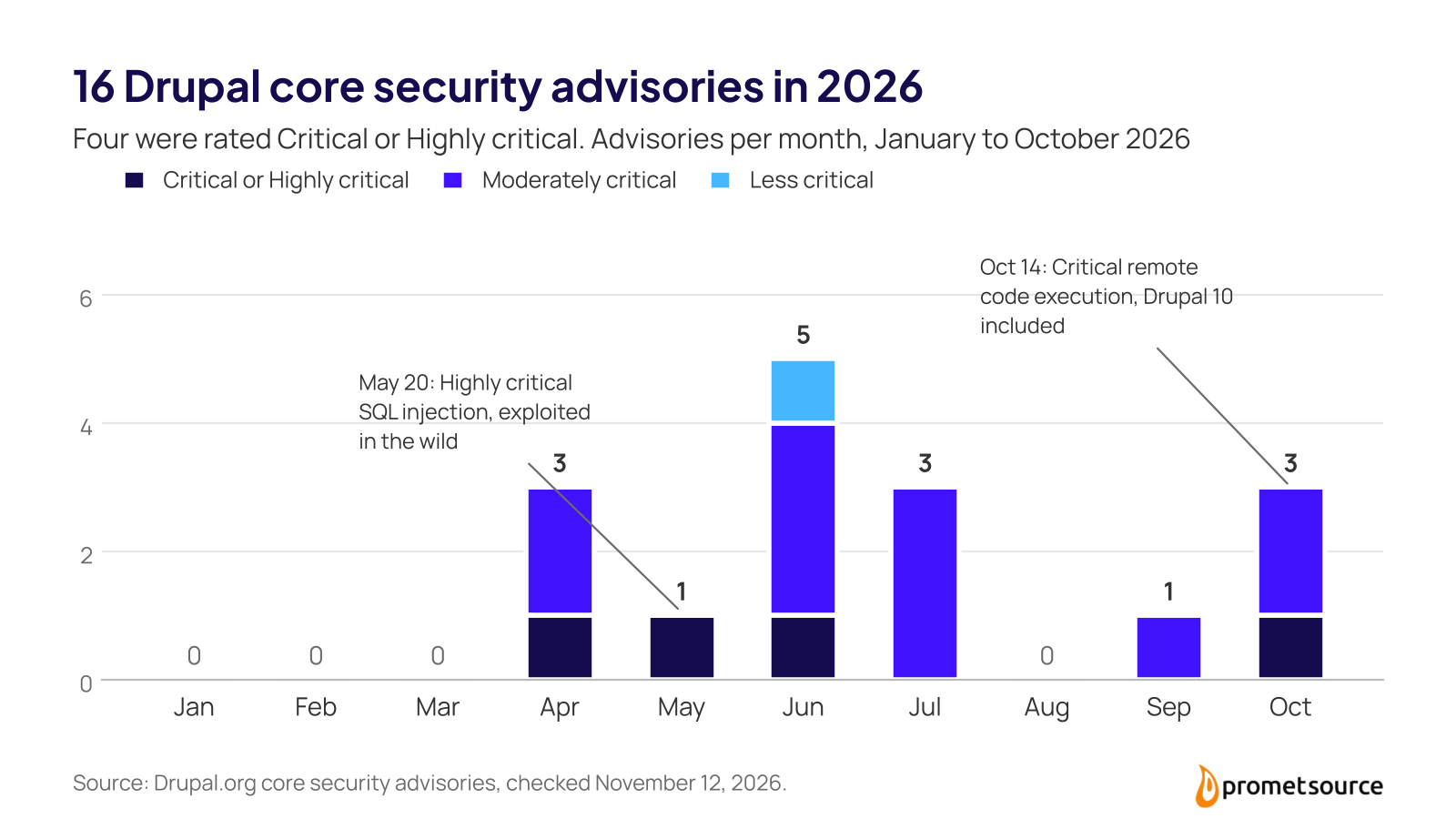
Your site will still load on December 10. What changes is the safety net, and 2026 shows how often that net gets used. Drupal.org has published 16 core security advisories so far this year, in April, May, June, July, September, and October, and four of them were rated Critical or Highly critical. A highly critical SQL injection advisory in May, which affected sites on PostgreSQL, was updated two days later because exploit attempts were being detected in the wild. A critical remote code execution advisory in October listed Drupal 10 versions as affected and shipped with a Drupal 10 patch. After December 9, fixes like these will cover Drupal 11 and Drupal 12 only.
When is the Drupal 12 release date?
Drupal 12 is released on December 9, 2026, the same day Drupal 10 reaches end of life, according to the Drupal core release schedule. The timing follows Drupal’s major release schedule, which has brought a new major version about every two years, in even years: Drupal 10 in December 2022, Drupal 11 in August 2024 and Drupal 12 in late 2026.
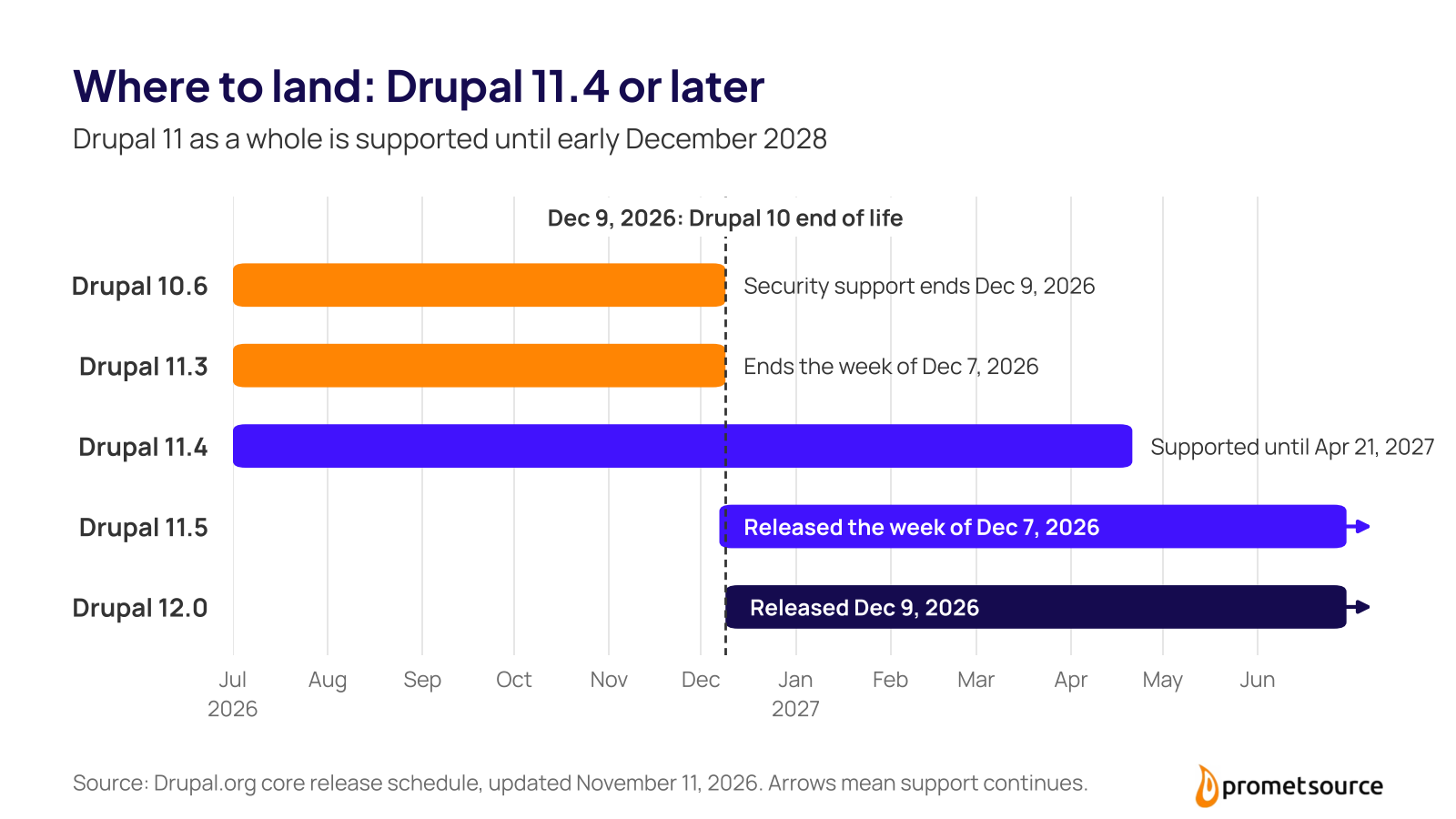
Drupal 10 sites can’t skip straight to Drupal 12. The continuous upgrade path runs through the latest Drupal 11 minor release, and Drupal 11 stays supported until early December 2028, so it is the right next step for site owners planning in advance.
Why are security issues now a weekly job?
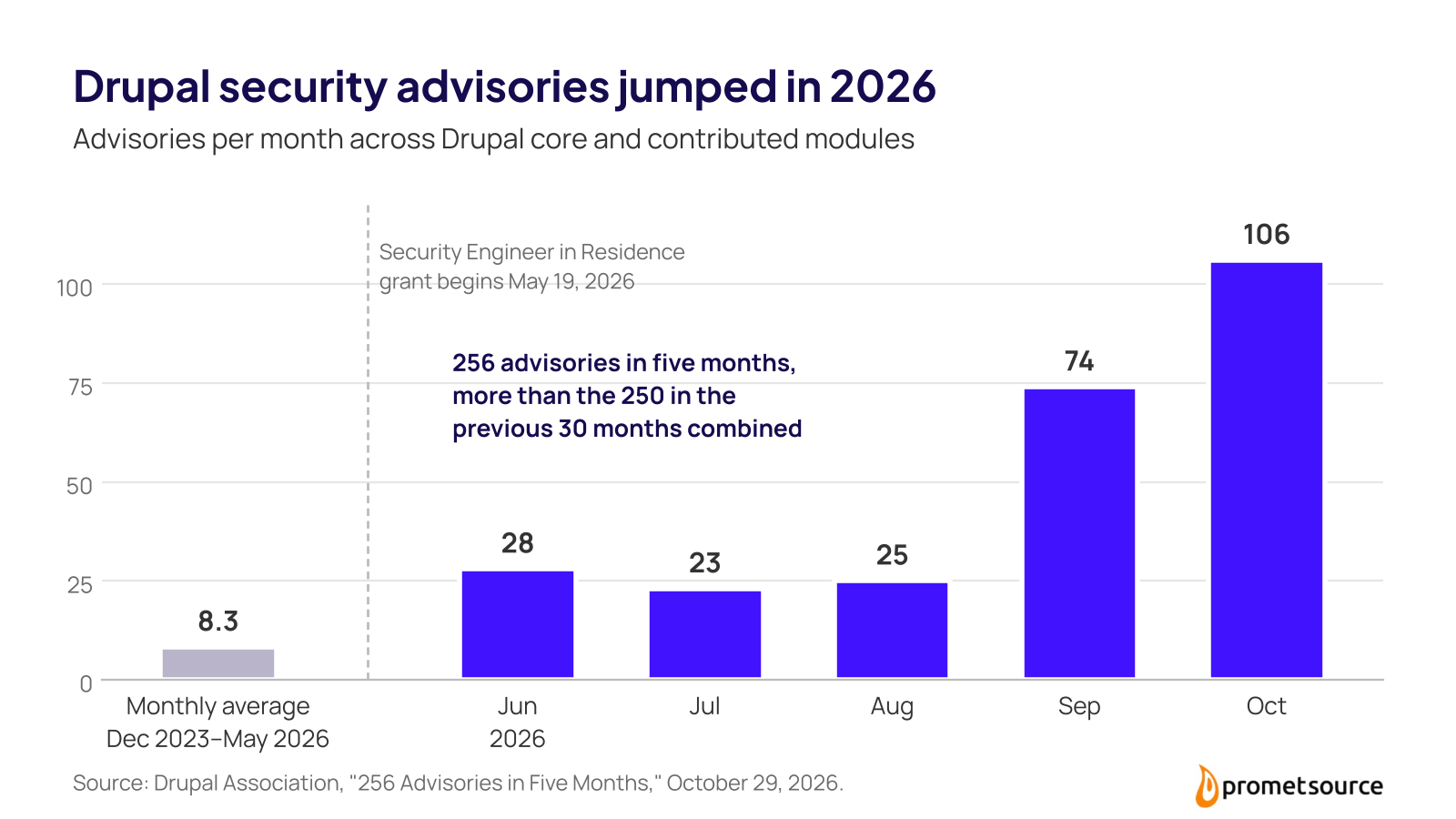
Across core and contributed modules, Drupal published 256 security advisories from June through October 2026, more than the 250 published in the previous 30 months combined, according to the Drupal Association. Most reports came from volunteers and outside researchers using AI tools. The association notes the surge reflects faster discovery, not a less secure codebase.
Drupal’s own security policy has changed because of it. In PSA-2026-11-02, an announcement published November 2, the Drupal Security Team cut security coverage for core minor versions from 12 months to eight, starting in 2027, citing the growing volume of AI-assisted security reports. Under the Drupal core release process, minor releases bring new features and API additions, while patch releases carry bug fixes and security patches, and only supported minor versions get them.
That pace changes how often a site needs attention. Drupal’s security release windows fall every Wednesday for contributed modules and on the third Wednesday of each month for core, and highly critical issues can ship outside those windows. October’s critical core advisory, for example, came out on the second Wednesday of the month.
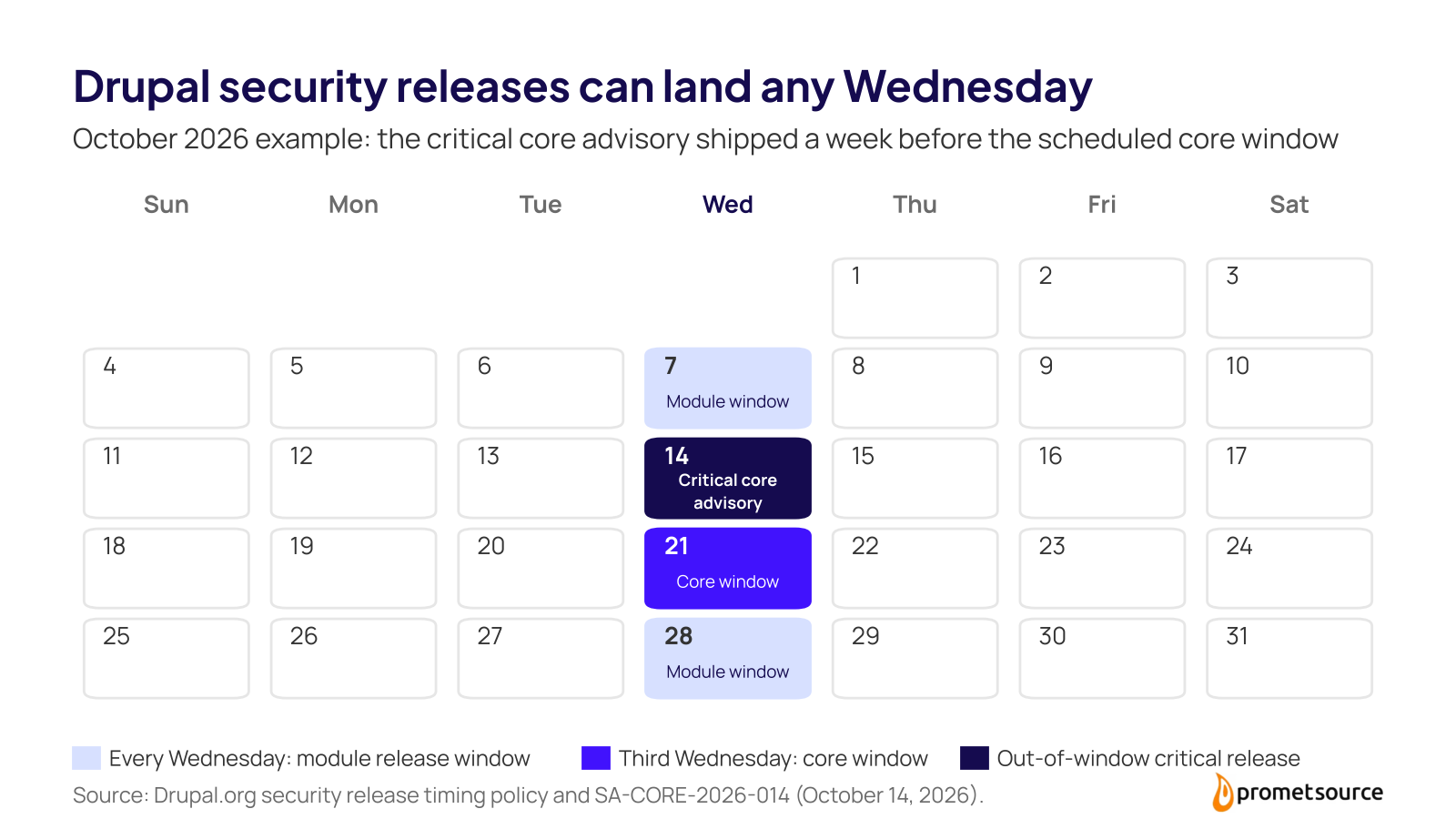
For a state & local government website, checking for security releases every week and applying critical fixes within days is becoming the baseline. A monthly or quarterly patch cycle leaves weeks in which a published vulnerability sits open on a site residents rely on. Staying on a supported version is becoming a routine part of running a public website, with less room for multiyear gaps.
Why does Drupal 10 end of life matter more for public agencies?
A government website carries resident data and online payments, so an unpatched core quickly becomes a public-trust problem. If your security policy or audit checklist asks whether public systems run supported software, a Drupal 10 site will answer no after December 9. We covered the wider case for a written patch policy in One in Ten Breaches Targets a Website.
Budget timing adds a second layer. According to NASBO, 46 states begin their fiscal year on July 1, which puts most state agencies about halfway through fiscal 2027 right now. An upgrade that was never scoped has no line item, and a mid-year request needs a defensible number behind it.
Our clients feel this tension already. As one of our county clients told us,
The path forward is not to wait ten years, when a new Drupal version comes out, we don’t want to be more than one or two years behind.
The goal is reasonable. The hard part is getting a firm scope early enough to fund it.
Why do Drupal 11 upgrade quotes come back as a range?
An upgrade estimate is only as firm as what the estimator can see. On a large public site, most of the effort hides in places a quick review won’t reach, so the risk gets priced in as a wide range or as change orders later.
The Drupal.org upgrade guide spells out the baseline every site has to clear.
Drupal 11 requirements at a glance
| Checkpoint | What Drupal 11 requires | Where surprises come from |
|---|---|---|
| Starting version | Drupal 10.3.0 or later | Sites still on 10.2 or earlier need an interim update first |
| Target version | Drupal 11.4 or later (schedule) | 11.3 loses security support the same week as Drupal 10; 11.4 is supported until April 21, 2027, and 11.5 ships the week of December 7 |
| PHP | 8.3 or later | Hosting changes and older custom code that breaks on newer PHP |
| Database | MySQL 8.0+, MariaDB 10.6+, or PostgreSQL 16+ (requirements) | Server upgrades that involve a separate team or vendor |
| Removed core modules | Actions UI, Activity Tracker, Book, Forum, Statistics, and Tour are gone from core | Features residents still use that now need a contributed replacement |
| Removed core themes | Stable9 has been removed from core. Claro and Olivero are now deprecated. | A custom theme that uses a core theme as a parent might not work unless adding the contributed replacement |
| Contributed modules | Each one needs a Drupal 11 release | Modules with no maintainer, no Drupal 11 release, or patches that no longer apply |
| Custom code | Deprecated Drupal 10 APIs must be replaced | Years of custom modules and themes written against older APIs |
Drupal.org recommends the Upgrade Status module and Drupal Rector to find and fix deprecated code. Those tools are a good start. On a site with hundreds of dependencies, the slow part is deciding what to do with each module that has no clean path forward: port it, replace it, or retire it. Making those calls up front is what lets a team put a fixed price on a Drupal 11 upgrade.
During a recent public-sector Drupal 11 upgrade we inherited from another vendor, an immediate audit surfaced three contributed modules blocking the path forward: CKEditor 4, PDF Serialization, and Actions UI. We resolved this by disabling CKEditor 4 and Actions UI outright, and refactoring the views that depended on PDF Serialization to use the Entity Print module instead. By the time we took over the project, most of the Drupal 11 contrib ecosystem had already matured, so blockers like these were the exception rather than the rule.
What should agencies do before the December 9 deadline?
Few agencies can fund and launch an upgrade before December 9, and that is fine. The priority is to know exactly where your site stands and to keep it as safe as possible while the upgrade gets funded.
- Check your baseline today. In your Drupal admin, Reports > Status report shows your core, PHP, and database versions. Sites on Drupal 10.5 or earlier already lost security support the week of June 29, 2026, so they need to reach 10.6 first.
- Get on the latest Drupal 10.6 release and check for updates weekly. The final Drupal 10 security release is the best footing you will have after end of life. Until you move, review security releases every Wednesday.
- Inventory every module and its Drupal 11 status. List each contributed and custom module with its upgrade path, and scope the move to Drupal 11.4 or later. This list drives both the price and the timeline.
- Turn the inventory into a fixed scope. A budget holder can approve a number tied to a written list of fixes. A range with a discovery phase attached is much harder to move through procurement.
- Rehearse the upgrade away from production. Run it on a copy of the site, compare pages before and after with visual regression testing, and keep a database snapshot and rollback point ready.
- Pick a cutover window that fits your residents. Schedule the switch for your real low-traffic period, which for many agencies means steering clear of tax deadlines and election weeks.
Here is a list of hardening tactics that you can take if you won’t be able to upgrade before EOL.
- Keep Drupal 10 fully patched (core and contrib modules) until it’s December 9, 2026 end of life, and place the site behind a WAF such as Cloudflare as your primary compensating control after that date.
- Harden the application layer by enabling the Security Kit and Paranoia modules, enforcing 2FA on all admin accounts, making settings.php read-only, and blocking PHP execution in upload directories.
- Finally, set up automated offsite backups, file integrity monitoring, and log alerting so you can detect and recover from any compromise quickly.
What are your support options if the budget isn’t there this fiscal year?
Many agencies will run Drupal 10 past its end of life because the money is committed elsewhere. That is a manageable position when it is a documented decision with an end date.
Start by writing the risk down. Record the end-of-life date, the modules and custom code that block the upgrade, and the date you expect to move. Security officers and auditors can work with a plan that has a date on it.
Next, use the scope as your funding request. A module-by-module inventory with an effort estimate for each fix gives finance a concrete number for a mid-year request, or for a fiscal 2028 budget if you are on a July 1 cycle. It also protects the work already done, since the analysis stays valid as long as the codebase doesn’t change much.
Some third-party vendors sell extended security support for Drupal 10. It can buy time, but it is a paid bridge, and the upgrade still has to happen afterward.
Finally, keep the weekly patch rhythm going for everything that is still supported, including contributed modules and PHP, and treat any new core advisory after December 9 as a signal to revisit the timeline with your leadership. If your team can’t keep up with that cadence in-house, Fully Managed Updates can take it on.
Get a number you can take to procurement
The Drupal 10 end-of-life date won’t move, so start with what you can control: knowing exactly what’s on your site. Whether your upgrade ships in December or next summer, the work starts with the same inventory.
Promet Source offers a free Drupal 11 readiness scan for public-sector sites. Our team analyzes a copy of your site in an isolated environment, so production is never touched. Within 24 hours of getting access, you receive a readiness report covering your module inventory, deprecation findings, dependency issues, and the effort for each fix. The report is yours to keep, and a fixed-price upgrade proposal is there only if you want one.
Frequently asked questions about the Drupal 10 end of life
When does Drupal 10 reach end of life?
Drupal 10 reaches end of life on December 9, 2026, the same week Drupal 12 is released, according to the Drupal.org core release schedule. No new Drupal 10 releases will be made after that date, and W3Techs data from November 2026 shows 27.8% of Drupal websites still run version 10.
What does a Drupal 10 to Drupal 11 upgrade require?
Drupal requires sites to run Drupal 10.3.0 or later and PHP 8.3 or later before moving to Drupal 11. Six modules, including Book, Forum, and Statistics, were removed from core, and every contributed module needs a Drupal 11 release, which is why a module inventory sets the upgrade scope.
How long will Drupal 10 be supported?
Drupal 10 is supported until December 9, 2026, when it reaches end of life, according to the Drupal core release schedule. Only the 10.6 minor release still receives security fixes until then, because 10.5 lost support the week of June 29, 2026. After December 9, Drupal will publish no new Drupal 10 releases.
What is the difference between Drupal 10 and Drupal 11?
Drupal 11 requires PHP 8.3 or later and newer database versions, removes six modules from core, including Book and Forum, and stays supported until early December 2028, per Drupal.org. Drupal 10 reaches end of life on December 9, 2026, so Drupal 11 is the next supported step for every Drupal 10 site.
Does Drupal have a long term support version?
Drupal does not designate long term support releases. According to Drupal.org, major versions are supported for at least four years, and security patches go only to the supported minor releases of each major version. For Drupal 10, that support ends December 9, 2026.
Find out exactly what your Drupal 11 upgrade involves.

John Lutz is a Principal Drupal Developer at Promet Source. He writes about Drupal search, Solr, and CMS migration for state and local government.




Get our newsletter
Get weekly Drupal and AI technology advancement news, pro tips, ideas, insights, and more.