What Rochester's Early Start to City Website WCAG Compliance Teaches Agencies Facing the Title II Deadline

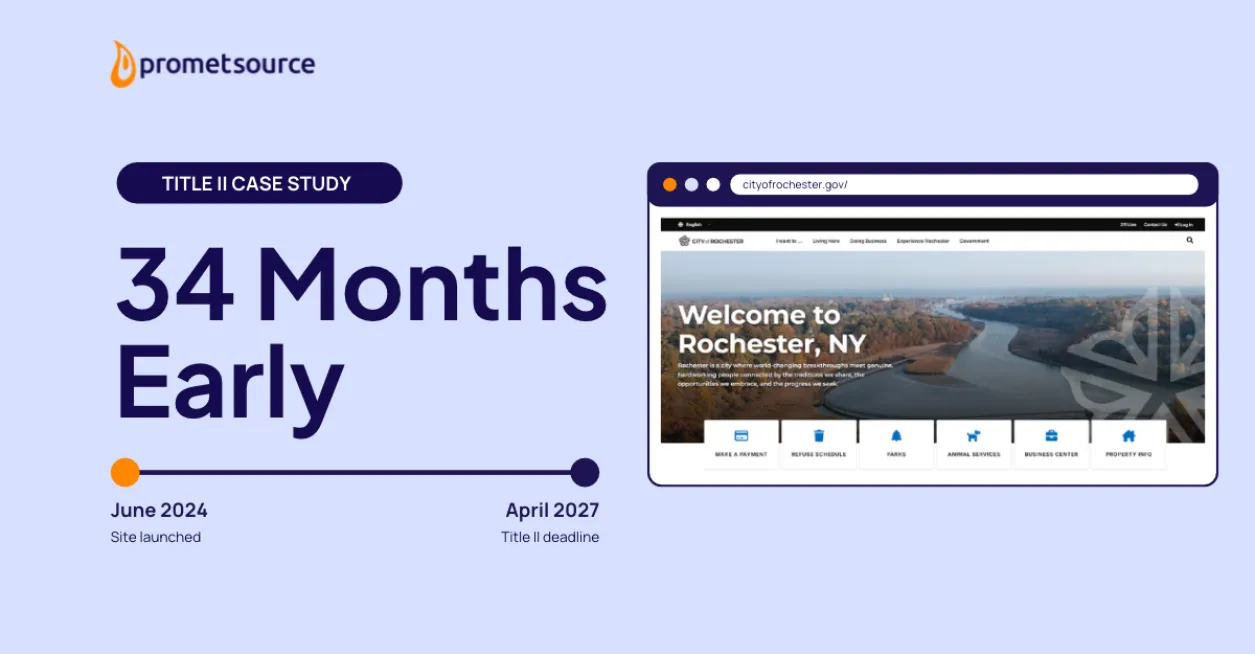
Table of Contents
Some version of this question comes up in most of my conversations with city and county IT teams lately: what did the agencies that started early actually do first? It's a fair question, and it's usually the first one in any conversation about city website WCAG compliance. Public agencies like to follow a path a peer has already walked, and with the Title II compliance date for cities and counties serving 50,000 or more people set for April 26, 2027, nobody has much time to experiment.
The City of Rochester, New York, home to more than 200,000 people, is the Title II accessibility case study I point to most often. Promet Source redesigned the city's website on Drupal with Provus®Gov, and I'm grateful to the city's team for pushing us the whole way. I'll admit some bias here, since our team built the site, so I'll stick to what the city and its partners have published. Here is what Rochester did, and how a team with less than five months can borrow from it.
How early did the City of Rochester start on Title II accessibility?
The City of Rochester, New York launched its rebuilt website on June 27, 2024, about 34 months before its April 26, 2027 Title II compliance date. Case studies published by Promet Source and Acquia report 100% WCAG 2.2 AA compliance for the new site, built on Drupal with Provus®Gov and hosted on Acquia.
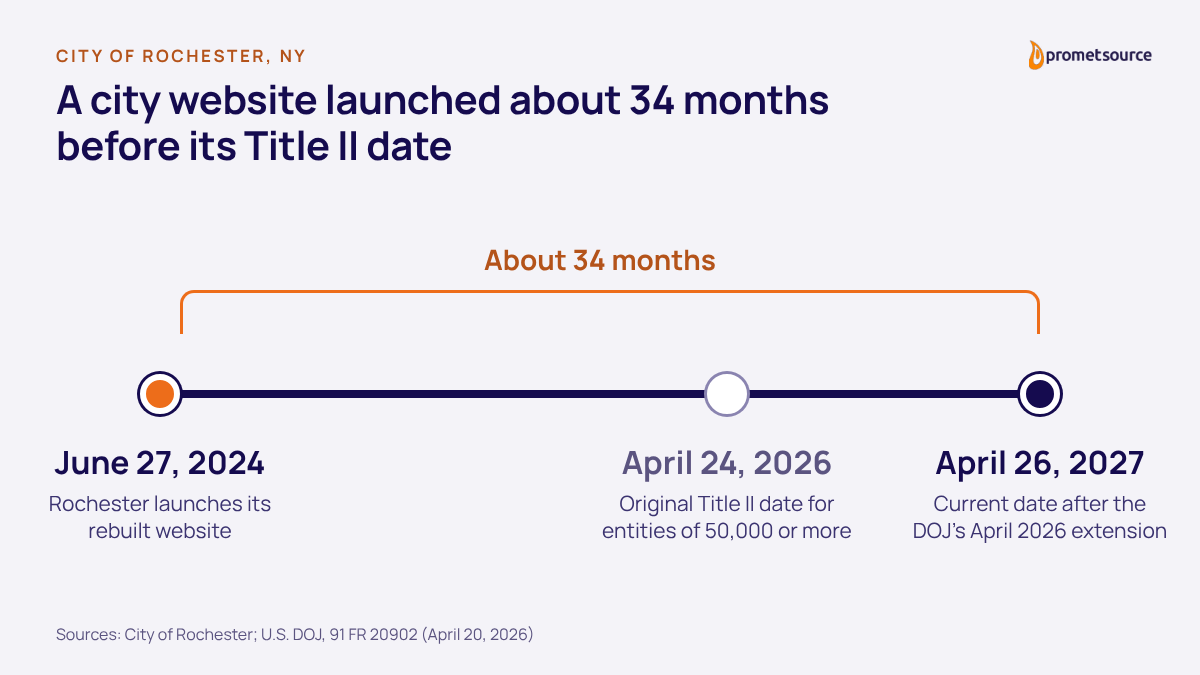
The timing looks even earlier against the rules in place at launch. The DOJ's 2024 rule originally gave entities of Rochester's size until April 24, 2026, so the city went live almost two years ahead of the date then on the books. The DOJ's April 2026 extension moved that date to April 26, 2027 (91 FR 20902), which added another year of margin.
The city's launch announcement highlighted improved screen reader support and expanded translation services alongside better accessibility overall. Those are the parts residents notice first, and they came out of decisions the city made well before launch day.
Does WCAG 2.2 AA conformance meet the Title II standard?
In general, yes. The DOJ's Title II rule adopts WCAG 2.1 Level AA, and WCAG 2.2 builds on 2.1 by adding nine success criteria and removing one obsolete criterion, 4.1.1 Parsing. The W3C states that content conforming to WCAG 2.2 also conforms to WCAG 2.1 and 2.0.
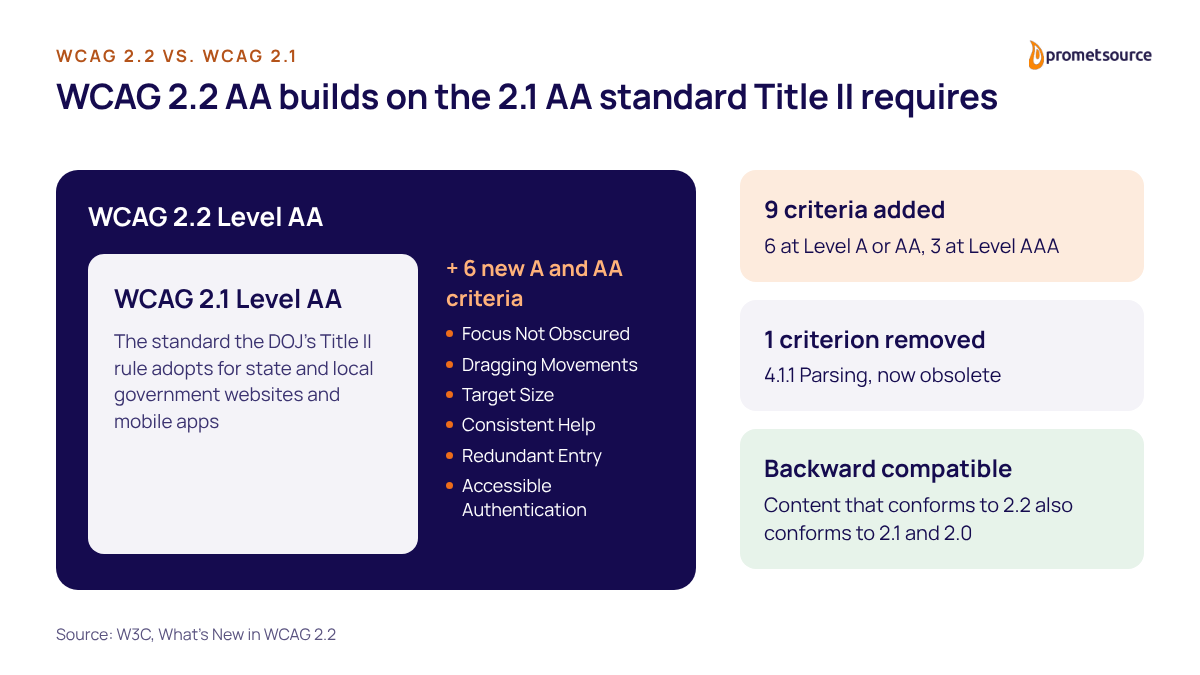
Teams working on city website WCAG compliance often ask whether they should build to 2.1, the version the rule names, or to 2.2. Building to 2.2 adds margin in places residents notice, such as keyboard focus that isn't hidden behind a sticky header and buttons large enough to tap on a phone. Our overview of what's new in WCAG 2.2 covers the full list of changes.
One caution I give every agency: a compliance percentage reflects what testing found at a point in time. Automated tools detect only part of what WCAG covers, and every new page a site publishes is a new chance for an error. Rochester's team understood that, which I'll come back to below.
What did Rochester do first?
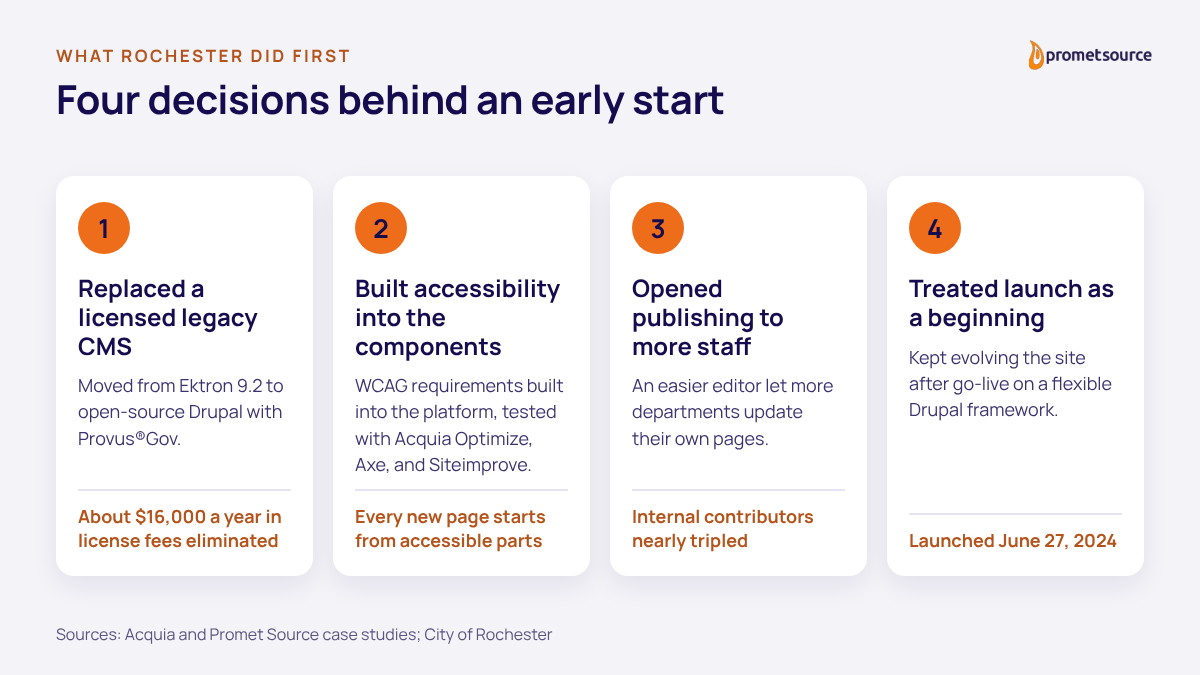
Rochester's early start on city website WCAG compliance came from platform and process decisions. The city replaced a licensed legacy CMS, eliminating about $16,000 a year in license fees, built WCAG requirements into its Provus®Gov components, and nearly tripled its internal website contributors, according to case studies from Acquia and Promet Source.
It replaced a platform that cost money to keep.
The city's previous site ran on Ektron 9.2, with annual license fees of $16,000 before infrastructure and maintenance costs, according to Acquia. That $16,000 a year paid to keep an aging platform running. Moving to open source took that license fee off the books, and Drupal gave Rochester a platform it can keep updating for years. I've believed for a long time that Drupal is a great fit for government, and this is a big part of why.
It built accessibility into the components.
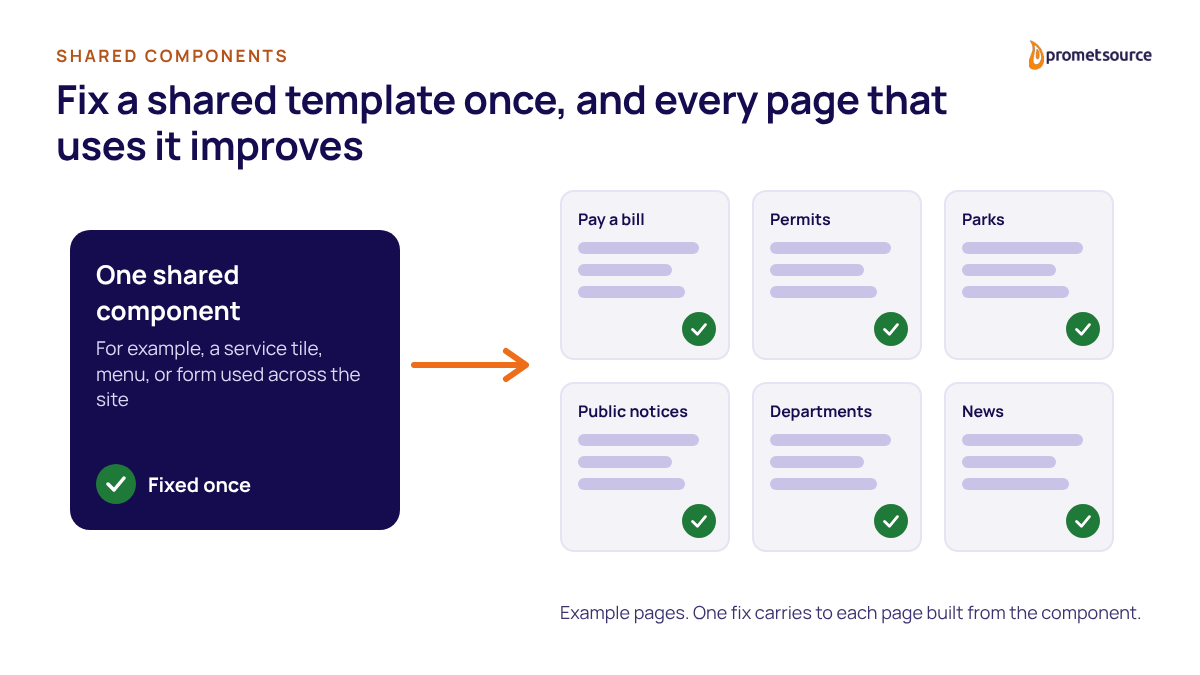
Acquia's case study describes WCAG 2.1 AA compliance built into the platform, with testing in Acquia Optimize, Axe, and Siteimprove. When the templates and components meet the standard, every page an editor assembles starts from accessible parts. Fixing a shared template is like fixing the leak once, which saves a lot of mopping: one fix carries across every page that uses that component.
It opened content publishing to more people.
The new website is so easy to use, we've nearly tripled the amount of internal website coordinators and contributors since work on the new site started.
—Ted Capuano, the city's Assistant Communications Director, in Promet Source's City of Rochester, NY case study.
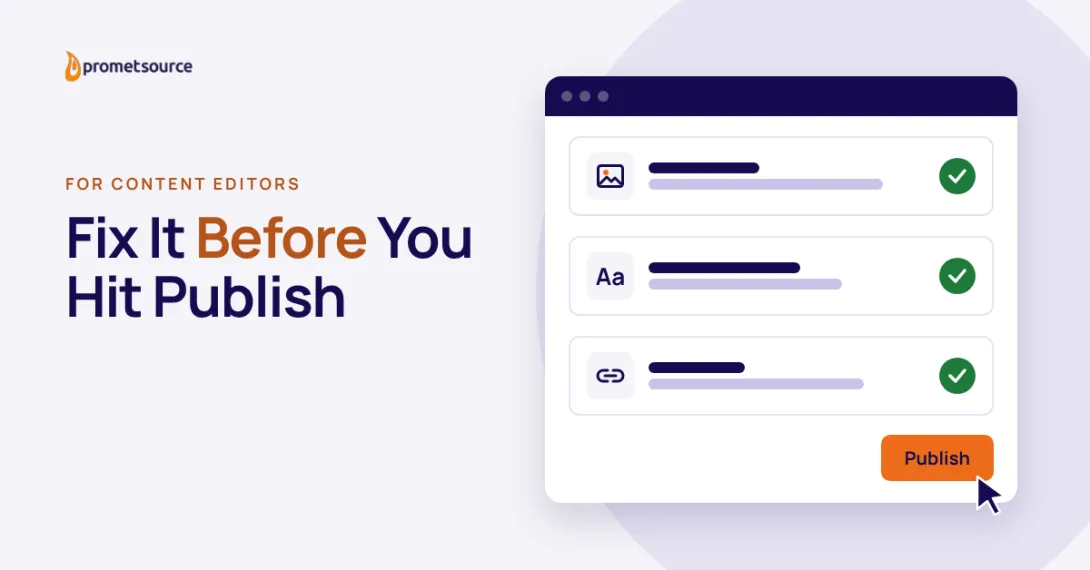
More contributors means more content decisions every day, which is why editor habits matter so much for Title II. My colleague Ashley Burns covers those habits in her guide to accessibility for content editors.
It treated launch as the start of the work.
Matt Driffill, the city's Digital Content Manager, noted that while a website launch "may seem like the end of the project, it's also the beginning." I'd add that the same holds for accessibility: ongoing testing and monitoring are what keep a conformant site conformant, and they are the subject of the next article in this series.
How can agencies apply Rochester's approach before April 26, 2027?
Agencies can apply Rochester's approach at a smaller scale before April 26, 2027 by fixing shared templates first, testing against WCAG 2.1 Level AA, and training the staff who publish. Rochester followed the same order on a longer timeline, launching about 34 months before its ADA Title II web compliance date (City of Rochester; 91 FR 20902).
I'll be candid. If your platform isn't already due for replacement, the next five months are a hard time to start a rebuild. Fix what every page shares first. The good news is that each of Rochester's decisions has a smaller version:
| What Rochester did | A first step with less than five months left |
|---|---|
| Replaced a licensed legacy CMS | Check when your platform license renews and whether the platform can support WCAG 2.1 AA, so the next budget request reflects it |
| Built accessibility into shared components | Audit and fix the templates, menus, and forms every page uses before fixing pages one at a time |
| Opened publishing to more staff | Train every editor on a short pre-publish checklist |
| Treated launch as a beginning | Schedule monitoring and periodic manual checks for after April 26, 2027 |
Sources: City of Rochester; Promet Source and Acquia case studies. Suggested first steps reflect Promet Source project experience.
If your agency hasn't set its plan yet, our article on the DOJ's Title II extension walks through how to put dates against each of these steps.
Frequently asked questions about city website WCAG compliance
Does WCAG 2.2 conformance satisfy ADA Title II?
Generally, yes. Title II requires WCAG 2.1 Level AA, and the W3C states that content conforming to WCAG 2.2 also conforms to WCAG 2.1. A site that meets WCAG 2.2 AA, as Rochester reported at launch, meets the version the rule names as well.
Do government and public entities websites have to be ADA compliant?
Yes. Under the DOJ's Title II rule, state and local government websites and mobile apps must meet WCAG 2.1 Level AA. Cities and counties serving 50,000 or more people have until April 26, 2027, and smaller entities and special district governments have until April 26, 2028 (91 FR 20902). Our article on the DOJ's extension covers the details.
Is WCAG 2.1 AA a legal requirement?
For state and local governments, yes. The DOJ's Title II rule adopts WCAG 2.1 Level AA as the technical standard for the web content and mobile apps they provide, directly or through contractors, with limited exceptions.
An early start is still within reach
Rochester's team had the advantage of time, and they used it on decisions that keep paying off, from lower platform costs to a larger group of people who can publish with confidence. We're proud of the work we did together, and even prouder of what the city's team has done with the site since. Most agencies reading this have a few months left, which is still enough time to fix the parts of a site that every page depends on, and the agencies that do will reach April 26, 2027 with a site that's easier to keep compliant afterward.
So here is the question I'd bring to your next team meeting: which shared template on your site would fix the most pages if your team corrected it this month?
This article is general information about the DOJ Title II rule, not legal advice. Talk with your agency's counsel about how the rule applies to your organization.
Want the full story behind Rochester's early start?

Andrew “Andy” Kucharski is the founder and CEO of Promet Source, a Chicago-based digital services company he has led since 2003. He brings more than 25 years of technical and project management experience across banking, telecommunications, government, and association technology, including work on secure systems for the Executive Office of the President and the U.S. Army. A recognized open-source advocate, he speaks regularly at Drupal events worldwide and writes about how public sector agencies can put AI, accessibility, and content strategy to practical use.


Get our newsletter
Get weekly Drupal and AI technology advancement news, pro tips, ideas, insights, and more.